Before booking an MOT, one of the easiest checks you can do at home is your tyre tread depth. Many UK drivers only think about tyres when a warning light appears, a tyre goes flat, or the MOT garage fails the car. But a simple tyre check can help you avoid an MOT failure, stay legal, and drive more safely in wet weather.
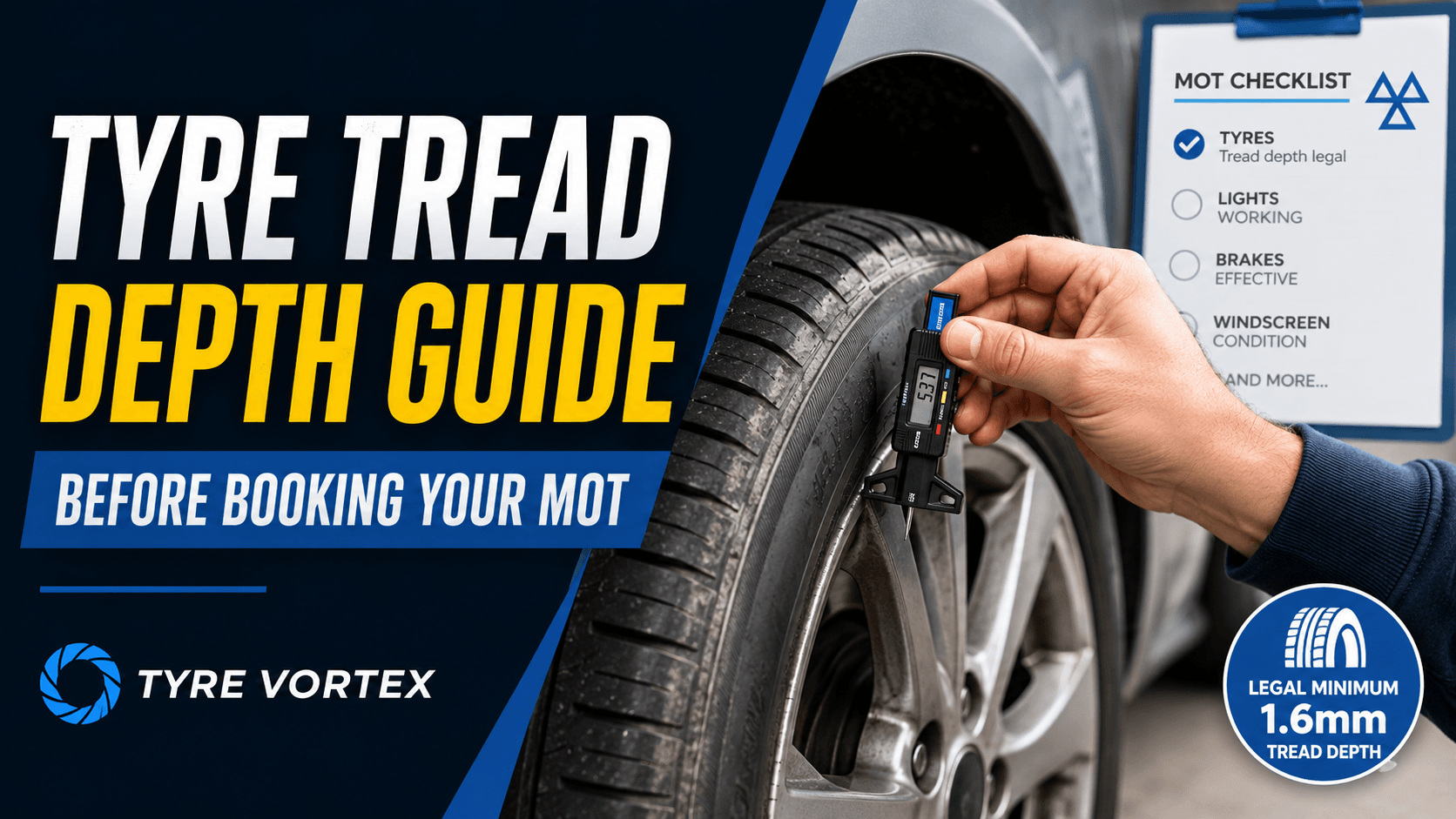
Your tyres are the only part of your car that touches the road. That means tread depth affects braking, steering, grip, cornering and water clearance. If your tyres are too worn, your car may take longer to stop, especially on wet roads. In the UK, most passenger cars need at least 1.6mm of tread depth across the central three-quarters of the tyre and around the full circumference to meet MOT requirements. GOV.UK’s MOT inspection manual confirms this requirement for passenger vehicles with up to 8 passenger seats, excluding the driver’s seat.
If you check your tyres before the MOT, you can replace worn or damaged tyres early. And if you need quick tyre replacement at home, work, or roadside, Tyre Vortex can help with mobile tyre fitting in its service areas.
Why Tyre Tread Depth Matters Before an MOT
Tyre tread is the patterned rubber on the outside of your tyre. The grooves are designed to clear water from the road surface and help the tyre stay in contact with the road. When tread gets low, the tyre becomes less effective at moving water away, which can increase the risk of aquaplaning and poor braking in wet conditions. TyreSafe explains that deeper tread helps clear water and maintain grip, while grip reduces as tread wears down.
For an MOT, tyre condition is not just about tread depth. The tester can also check for cuts, bulges, exposed cords, incorrect tyre fitment, serious valve damage, TPMS faults and under-inflation. GOV.UK lists tyre tread depth not meeting requirements as a dangerous defect, while tyre bulges, tears or cord exposure can also be dangerous defects.
That is why a home tyre check should include three things:
- Tread depth
- Tyre condition
- Tyre pressure and warning lights
What Is the Legal Tyre Tread Depth in the UK?
For most UK cars, the legal minimum tread depth is 1.6mm. This must be across the central three-quarters of the tyre’s tread and around the entire outer circumference of the tyre.
In simple words, your tyre cannot just have enough tread in one small area. You need to check several points around the tyre because tread can wear unevenly. One side may look fine while the inner edge is nearly bald. This is common when wheel alignment is off, suspension parts are worn, or tyres have been driven under-inflated.
Although 1.6mm is the legal minimum, many safety experts recommend replacing tyres before they reach that point. TyreSafe says safety experts commonly advise replacing tyres at 3mm, and checking tyres monthly or before long journeys.
The 20p Test: The Easiest Home Method
The 20p test is the quickest way to check whether your tyre tread is likely above the legal limit. You do not need tools, and it takes less than a minute per tyre.
How to do the 20p tyre tread test
Take a 20p coin and insert it into the main tread grooves of the tyre. Make sure you place the coin into the deeper central grooves, not the small shallow lines on the edge. If the outer band of the 20p coin is hidden, your tread is likely above the legal limit. If you can see the outer band of the coin, your tyre may be too worn and should be checked properly with a tread depth gauge or by a tyre professional. TyreSafe recommends the 20p test as an easy way to check if car tyre tread is above the legal minimum.
Do this test in at least three places on each tyre:
- Inner side of the tread
- Centre of the tread
- Outer side of the tread
Also move the car slightly forward or backward so you can check another part of the tyre’s circumference. A tyre may have uneven wear that is not visible from one angle.
Use a Tyre Tread Depth Gauge for a More Accurate Check
The 20p test is useful, but a tread depth gauge gives a more accurate reading in millimetres. These small tools are inexpensive and easy to use.
To use a tread depth gauge:
- Park on a flat surface and apply the handbrake.
- Place the gauge probe into a main tread groove.
- Push the gauge base flat against the tyre.
- Read the measurement in millimetres.
- Repeat across different parts of the tyre.
If your reading is close to 1.6mm, do not wait until your MOT. A tyre at 1.7mm may still technically pass in one part, but it may be below the limit somewhere else. It can also become illegal very quickly with normal driving.
For safer planning, many drivers replace tyres around 3mm, especially if they drive long distances, use motorways, or drive often in rain.
Check Built-In Tread Wear Indicators
Most tyres have small raised bars inside the main grooves. These are called tread wear indicators, or TWIs. When the tyre tread wears down level with these bars, the tyre is at or near the legal minimum.
GOV.UK explains that primary grooves are the grooves containing tread wear indicators or those originally moulded to the same depth. These are the important grooves used when assessing tread depth.
To find tread wear indicators, look along the sidewall of the tyre. Many tyres have a small triangle, arrow, or “TWI” marking that points towards the location of the wear bar. If the tread is level with the wear bar, your tyre needs replacing.
Do Not Only Check the Front Tyres
Many drivers check only the front tyres because they are easier to see. This is a mistake. Rear tyres can also wear, crack, bulge, or become damaged by potholes and kerbs.
Check all four tyres:
- Front left
- Front right
- Rear left
- Rear right
Also check the spare tyre if your car has one. Some modern vehicles do not have a spare and instead come with a repair kit. If your tyre is badly worn or damaged, a repair kit will not solve the problem.
If one tyre is illegal, your car can fail the MOT. If more than one tyre is worn, the risk becomes even greater. TyreSafe says driving with tyres below the legal minimum can lead to fines of up to £2,500 and three penalty points per tyre.
Look for Uneven Tyre Wear
Tread depth is important, but the pattern of wear also tells you a lot about your car. Uneven wear can mean there is another issue that needs fixing.
Inner edge wear
If the inside edge of the tyre is worn more than the rest, it may be caused by poor wheel alignment or suspension issues.
Outer edge wear
Outer shoulder wear can happen from under-inflation, aggressive cornering, or alignment problems.
Centre wear
If the centre of the tyre is more worn than the edges, the tyre may have been over-inflated.
Both edges worn
If both outer edges are worn, the tyre may have been under-inflated for a long time.
Patchy or uneven wear
Patchy wear may point to wheel balancing, suspension, or shock absorber issues.
If you see uneven wear, replacing the tyre may not be enough. You may also need wheel alignment or a mechanical check to stop the new tyre from wearing out quickly.
Check for Tyre Damage Before the MOT
Even if your tread depth looks fine, damage can still cause an MOT failure. Look carefully at the sidewall and tread area.
Watch for:
- Bulges or lumps
- Deep cuts
- Cracks in the rubber
- Exposed cords
- Nails or screws
- Sidewall damage
- Tyre valve damage
- Objects stuck in the tread
A bulge is especially serious. It can mean the tyre structure has been damaged, often after hitting a pothole or kerb. Do not ignore it. A tyre with a bulge can fail suddenly and should be replaced as soon as possible.
Check Tyre Pressure Too
Tyre pressure affects tread wear, fuel economy and handling. Under-inflated tyres can wear on the edges and overheat. Over-inflated tyres can wear in the centre and reduce road contact.
Check your tyre pressures when the tyres are cold. You can usually find the correct pressure in your car handbook, fuel flap, door frame or manufacturer information.
Also look at your TPMS warning light. GOV.UK’s MOT manual says TPMS inspection applies to M1 vehicles first used on or after 1 January 2012, and a malfunctioning or obviously not working TPMS can be a major defect.
If your tyre pressure warning light is on, check the pressure first. If the light stays on after correcting pressure, get it checked before your MOT.
When Should You Replace Tyres Before an MOT?
You should consider replacing your tyres before the MOT if:
- Tread depth is close to 1.6mm
- The 20p coin outer band is visible
- Wear bars are level with the tread
- You see cracks, cuts, bulges or exposed cords
- One edge of the tyre is badly worn
- The tyre keeps losing pressure
- Your TPMS warning light stays on
- The tyre has been damaged by a pothole or kerb
Waiting until the MOT can create stress, delays and extra costs. If the car fails, you may need urgent tyre replacement before it can pass. A quick home check gives you time to book a replacement properly.
How Tyre Vortex Can Help
If your tyres are worn, damaged, or close to the legal limit, Tyre Vortex offers a convenient mobile tyre fitting solution. Instead of driving to a garage with risky tyres, you can arrange mobile tyre fitting at your home, workplace or roadside location within Tyre Vortex service areas.
Tyre Vortex can help with:
- Mobile tyre fitting
- Emergency tyre replacement
- Roadside tyre assistance
- Puncture-related support
- Same-day tyre fitting where available
- Tyre replacement before MOT
This is especially useful if your MOT is coming soon and you do not want to risk driving on unsafe tyres.
Final Checklist Before Booking Your MOT
Before you book your MOT, do this quick tyre check:
- Use the 20p test on all four tyres
- Measure tread depth with a gauge if possible
- Check inner, middle and outer tread areas
- Look for uneven wear
- Inspect sidewalls for bulges, cracks and cuts
- Check tyre pressure
- Check the TPMS warning light
- Replace any unsafe or borderline tyres early
A few minutes of checking can save you from MOT failure, legal problems and unsafe driving.
Conclusion
Checking tyre tread depth at home is simple, but it is one of the most important things you can do before an MOT. The legal minimum for most UK cars is 1.6mm, but waiting until your tyres reach that point is not always the safest choice. Use the 20p test, check with a tread depth gauge, inspect your tyre condition and look for uneven wear.
If your tyres are worn, damaged or close to the limit, Tyre Vortex can help with mobile tyre fitting, making tyre replacement easier before your MOT. Safe tyres do not just help you pass the MOT — they help protect you, your passengers and other road users.