Electric van MOT rules are changing from 1 June 2026, and UK van drivers, fleet operators, couriers, tradespeople, and delivery businesses should understand what the update means before their next test.
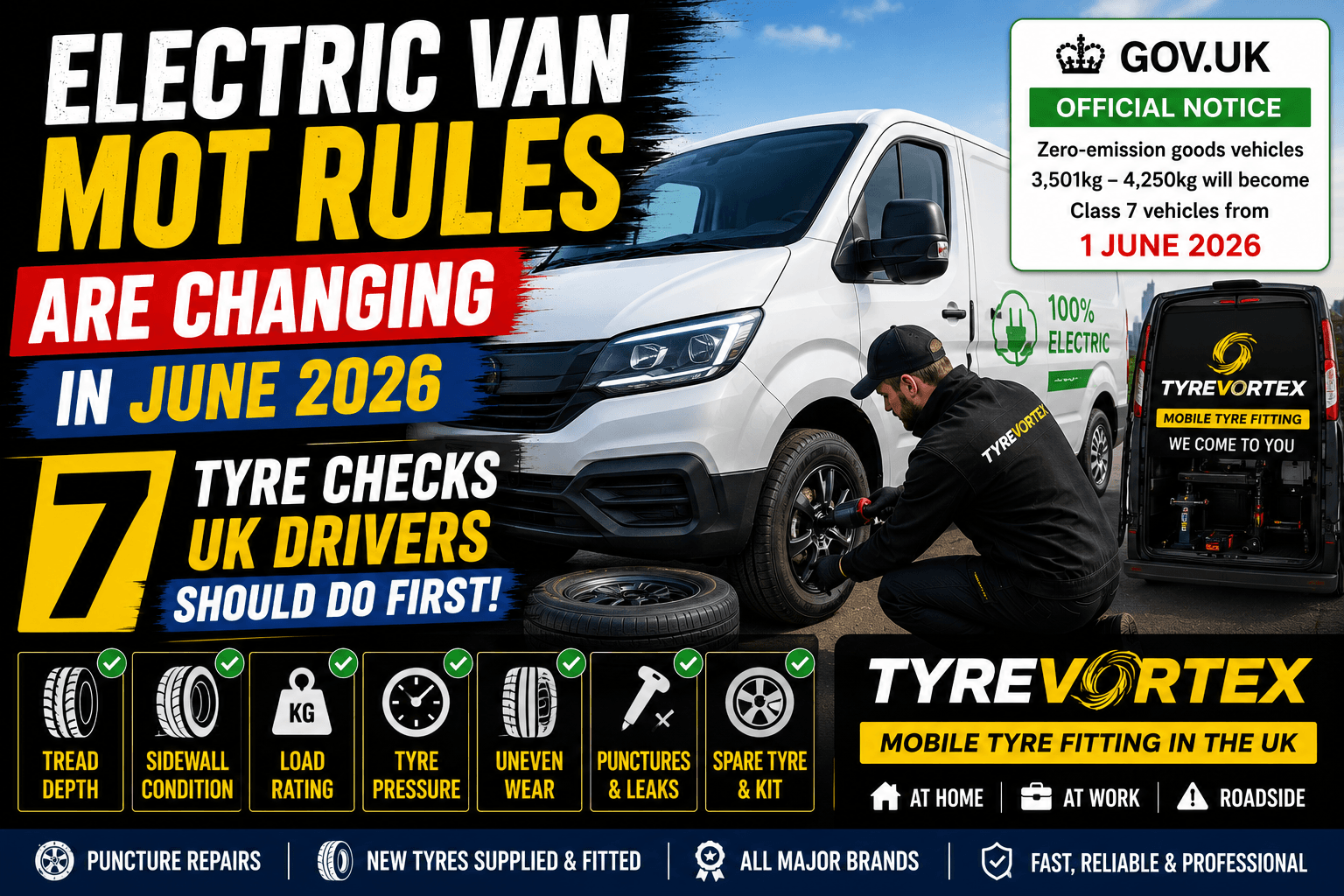
According to the official GOV.UK MOT special notice 01-26, zero-emission goods vehicles with a design gross weight between 3,501kg and 4,250kg will become Class 7 vehicles from 1 June 2026. These vehicles will need a Class 7 MOT test, and their first Class 7 MOT will be due 3 years after registration. You can read the official GOV.UK notice here: GOV.UK MOT special notice 01-26.
For many electric van owners, this is a major update. It affects heavier zero-emission vans that sit above 3.5 tonnes but do not exceed 4.25 tonnes. These vans are often used by couriers, fleet operators, logistics businesses, mobile trades, and delivery drivers.
But this is not just an MOT rule change. It is also a reminder for UK van drivers to check tyre safety early. Electric vans can be heavier than petrol or diesel vans because of their battery packs. That extra weight can place more demand on tyres, especially when the van is carrying tools, parcels, stock, equipment, or commercial loads.
For drivers who rely on their vans every day, a tyre problem can quickly become a serious issue. It can cause MOT failure, roadside delays, missed jobs, delivery disruption, or unsafe driving conditions.
That is where TyreVortex mobile tyre fitting in the UK can help. TyreVortex supports van drivers, electric van owners, courier drivers, tradespeople, and fleet operators with mobile tyre fitting and emergency tyre replacement, helping drivers reduce downtime without needing to visit a garage.
Quick Answer: What Is Changing for Electric Van MOTs?
From 1 June 2026, zero-emission goods vehicles between 3,501kg and 4,250kg design gross weight will become Class 7 vehicles for MOT testing. They will need a Class 7 MOT test, with the first test due 3 years after registration, according to GOV.UK MOT special notice 01-26.
Which Electric Vans Are Affected?
The rule applies to zero-emission goods vehicles with a design gross weight between:
3,501kg and 4,250kg
This usually affects larger electric vans and commercial zero-emission vehicles used for business purposes.
Examples of drivers and businesses that may be affected include:
- Courier drivers
- Delivery companies
- Fleet operators
- Tradespeople
- Mobile service businesses
- Local logistics companies
- Electric van owners using heavier commercial vehicles
If your electric van is under 3,500kg, it may already fall under the standard light commercial MOT system. If your vehicle is between 3,501kg and 4,250kg, this new Class 7 MOT update may apply to you.
Drivers should check the vehicle’s design gross weight, sometimes shown as maximum authorised mass, on the vehicle plate, V5C logbook, or manufacturer documents.
Why This MOT Change Matters for UK Van Drivers
Electric vans are becoming more common across the UK as businesses move towards lower-emission transport. Many drivers are choosing electric vans for deliveries, trade work, local services, and fleet operations.
However, electric vans can place different demands on tyres compared with traditional vans. Battery weight, instant torque, heavy commercial loads, and daily stop-start driving can all contribute to tyre wear.
That means tyre checks should not be left until MOT day.
A tyre that looks fine from a distance may still have:
- Low tread depth
- Sidewall damage
- Uneven wear
- Incorrect pressure
- Wrong load rating
- A slow puncture
- Damage from kerbs, potholes, or debris
Tyres are one of the most important safety parts of any van because they are the only contact point between the vehicle and the road. For electric van drivers, tyre condition can also affect range, braking distance, handling, energy efficiency, and driver safety.
Why Tyres Matter More on Electric Vans
Electric vans often carry extra weight because of their battery systems. When combined with business loads, tools, parcels, or equipment, the tyres may work harder than many drivers realise.
Instant torque from electric motors can also place extra stress on tyres during acceleration. This does not mean electric vans are unsafe. It simply means tyre maintenance is extremely important.
Poor tyre condition can lead to:
- MOT failure
- Reduced braking performance
- Poor wet-weather grip
- Lower electric range
- Increased tyre wear
- Higher running costs
- Greater risk of roadside breakdown
For businesses, this can mean lost time and lost income. A van stuck at the roadside cannot complete deliveries, reach customers, or finish jobs.
This is why TyreVortex mobile tyre fitting UK can be useful for electric van drivers. Instead of taking the van to a tyre garage, mobile tyre fitting allows tyre support to come to your location where suitable, including home, workplace, job site, or roadside.
7 Tyre Checks UK Electric Van Drivers Should Do First
1. Check Tyre Tread Depth
Tyre tread depth is one of the most important MOT checks.
For cars and light vans, the UK legal minimum tread depth is 1.6mm across the central three-quarters of the tyre and around the entire circumference. GOV.UK also states that tyres must be correctly inflated to the vehicle manufacturer’s specification for the load being carried.
Even though 1.6mm is the legal minimum, van drivers should not wait until tyres are right on the limit. Electric vans can be heavier, and worn tyres may reduce grip, especially on wet roads.
Check tread depth regularly using a tread depth gauge. You can also look at tread wear indicators on the tyre. If your tyres are close to the legal limit, replace them before they become a problem.
For electric vans used daily, especially for deliveries or trade work, regular tread checks can help prevent MOT failure and roadside tyre emergencies.
2. Inspect Tyre Sidewalls for Cuts, Cracks, and Bulges
Sidewall damage can be dangerous. Cuts, cracks, bulges, and exposed cords may indicate that a tyre is unsafe.
Electric vans often operate in busy environments such as loading bays, industrial estates, city streets, kerbside parking areas, and construction zones. These areas increase the chance of sidewall damage from kerbs, potholes, debris, and sharp objects.
A bulge in the sidewall should never be ignored. It can mean the internal structure of the tyre has been damaged.
Walk around the van and inspect each tyre carefully. Look at both the outer and inner edges where possible. If you spot sidewall damage, get professional tyre help before continuing long journeys.
3. Make Sure Tyres Have the Correct Load Rating
Load rating is especially important for electric vans.
Because electric vans can be heavier than similar diesel vans, they need tyres that are suitable for the vehicle’s weight and expected load. A van carrying tools, stock, parcels, or equipment may often be operating close to its maximum weight.
Using tyres with the wrong load rating can affect safety, handling, tyre life, and vehicle performance.
Check the tyre size and load index against the manufacturer’s recommendation. You can usually find this information in the vehicle handbook, on the vehicle plate, or through a professional tyre fitter.
For fleet operators, load rating checks should be part of regular maintenance. It is not enough to fit a tyre that simply matches the wheel size. The tyre must also be suitable for the weight and usage of the van.
4. Check Tyre Pressure Regularly
Incorrect tyre pressure is one of the most common causes of poor tyre performance.
Underinflated tyres can increase rolling resistance, reduce electric range, create excess heat, and cause faster wear. Overinflated tyres can reduce road contact and lead to uneven wear.
Electric van drivers should check tyre pressures when the tyres are cold and follow the manufacturer’s recommended pressure settings. Some vans have different pressure recommendations depending on whether the vehicle is lightly loaded or fully loaded.
For business drivers, tyre pressure should be checked at least weekly and before long journeys.
Correct tyre pressure can help improve:
- Safety
- Range
- Braking
- Tyre life
- Handling
- Running costs
For electric vans, correct pressure can also support better battery efficiency by reducing unnecessary rolling resistance.
5. Look for Uneven Tyre Wear
Uneven tyre wear can be a warning sign.
If one side of the tyre is wearing faster than the other, it may suggest wheel alignment, suspension, or pressure problems. If the centre of the tyre is wearing faster, the tyre may be overinflated. If both outer edges are wearing faster, the tyre may be underinflated.
Electric vans used in urban areas may develop uneven wear due to frequent stopping, turning, kerb contact, and heavy loads.
Do not ignore uneven wear. Replacing the tyre without fixing the cause may mean the new tyre wears out quickly too.
If you notice uneven wear, arrange a professional inspection. You may need wheel alignment, suspension checks, or pressure adjustments.
6. Check for Punctures, Nails, and Slow Leaks
Slow punctures are common for working vans.
Courier drivers, builders, tradespeople, and delivery drivers often drive through areas where sharp objects are common. Nails, screws, glass, metal pieces, and road debris can become embedded in the tyre.
A slow puncture may not cause immediate failure, but it can gradually reduce pressure and make the tyre unsafe.
Look for visible objects in the tread and monitor whether one tyre loses pressure faster than the others. If you keep topping up the same tyre, there may be a slow leak.
A puncture may be repairable if it is located in the repairable area of the tread and the tyre is otherwise safe. But if the damage is near the sidewall or the tyre has been driven while underinflated, replacement may be needed.
This is where TyreVortex emergency mobile tyre fitting in the UK can help. If your electric van has a puncture or tyre damage, mobile tyre support can reduce downtime and help get your van moving again.
7. Check Your Spare Wheel or Emergency Repair Kit
Many modern vans do not come with a full-size spare wheel. Some have a tyre repair kit or inflation kit instead.
Before the MOT rule change begins, check what your electric van actually has.
You should know whether your van has:
- Spare wheel
- Locking wheel nut key
- Jack
- Wheel brace
- Tyre sealant kit
- Inflation kit
- Roadside assistance cover
A missing locking wheel nut key can turn a simple tyre replacement into a much bigger delay. A flat spare tyre is also useless in an emergency.
For business drivers, checking emergency equipment can prevent wasted time when something goes wrong.
Mobile Tyre Fitting for Electric Vans in the UK
Electric van drivers depend on their vehicles every day. A tyre problem can stop deliveries, delay jobs, or leave a driver stranded.
TyreVortex offers mobile tyre fitting in the UK, helping van drivers, electric van owners, courier drivers, tradespeople, and fleet operators deal with tyre problems without unnecessary garage visits.
Mobile tyre fitting can be useful if your electric van has:
- A puncture
- Worn tyres before MOT
- Low tread depth
- Damaged sidewalls
- Uneven tyre wear
- Incorrect load-rated tyres
- A roadside tyre emergency
With mobile tyre fitting, tyre support can come to your location where suitable. This may include your home, workplace, job site, depot, or roadside location.
For fleet operators, mobile tyre fitting can reduce downtime because vehicles do not always need to be taken out of service for a garage visit. For self-employed van drivers, it can help save valuable working time.
Before the June 2026 electric van MOT rule change, UK drivers should inspect their tyres and replace any that are worn, damaged, or unsuitable for the vehicle load.
What Fleet Operators Should Do Before June 2026
Fleet operators should use this MOT update as a reminder to review electric van maintenance schedules.
Before 1 June 2026, fleet managers should:
- Identify affected zero-emission vans
- Check each vehicle’s design gross weight
- Update MOT planning records
- Review tyre inspection routines
- Check tyre load ratings
- Train drivers to report tyre issues
- Keep records of tyre replacements and repairs
- Arrange tyre replacement before tyres reach the legal limit
A simple weekly tyre checklist can help prevent avoidable MOT problems and reduce roadside breakdowns.
Fleet vehicles often cover high mileage and operate under pressure. A small tyre issue can become expensive if it causes a van to miss deliveries or remain off the road.
Need Mobile Tyre Fitting for Your Electric Van?
If your electric van has a puncture, worn tyre, sidewall damage, low pressure issue, or roadside tyre emergency, TyreVortex can help with mobile tyre fitting in the UK.
TyreVortex supports UK van drivers who cannot afford unnecessary downtime. Whether your van is at home, work, on-site, at a depot, or stuck roadside, mobile tyre fitting can help you get back on the road faster.
Before the June 2026 MOT rule change comes in, now is a smart time to check your tyres, confirm your load rating, and replace any tyres close to the legal limit.
Need urgent tyre help? Contact TyreVortex for mobile tyre fitting in the UK.
Final Thoughts
Electric van MOT rules are changing from 1 June 2026, and zero-emission goods vehicles between 3,501kg and 4,250kg will become Class 7 vehicles for MOT testing.
For UK electric van drivers, the message is simple: do not wait until MOT day to check your tyres.
Check tread depth, sidewalls, load rating, tyre pressure, uneven wear, punctures, and emergency equipment now. These checks can help reduce MOT failure risk, improve road safety, protect your van, and prevent costly downtime.
And if you find worn tyres, punctures, sidewall damage, or load rating concerns, TyreVortex mobile tyre fitting in the UK can help you replace tyres quickly and keep your electric van moving.