Your car can fail its MOT if the tyres are worn, damaged, under-inflated, incorrectly fitted, unsafe, or below the legal tread depth. In the UK, most passenger cars need at least 1.6mm tread depth across the central three-quarters of the tyre and around the full circumference. GOV.UK’s MOT manual lists tyre tread depth, tyre condition, TPMS faults, damaged valves, incorrect fitment and exposed cords as MOT issues.
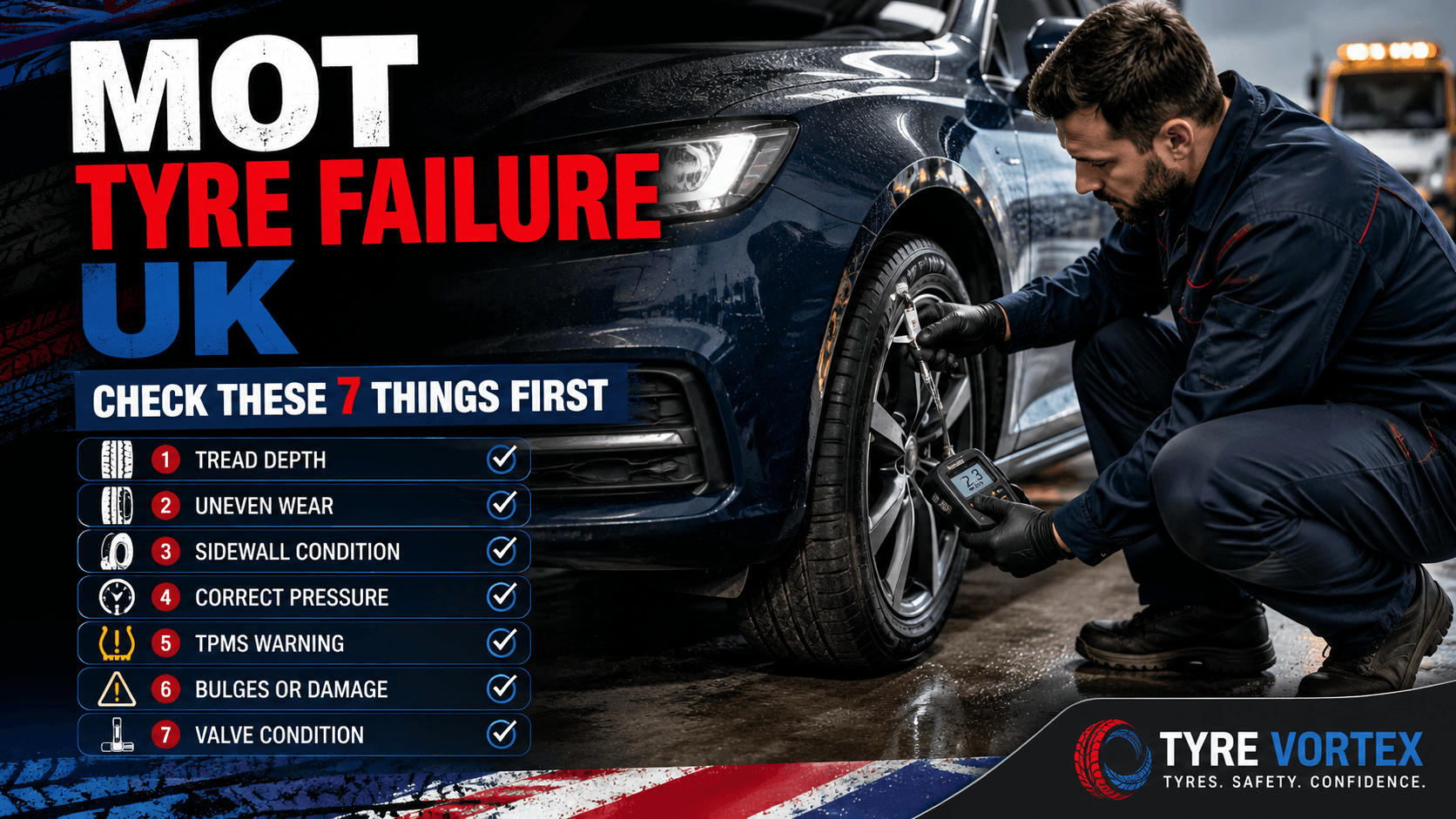
Tyres are one of the easiest things to check before an MOT, yet they are still a major reason for failure. TyreSafe says over 2 million MOT failures happen each year because of tyre defects, with around one million classed as dangerous. Before you book your MOT, Tyre Vortex recommends checking these seven tyre points.
1. Check Tyre Tread Depth
The legal minimum tread depth for UK car tyres is 1.6mm. The tread must meet this limit across the central three-quarters of the tyre and around the full outer circumference.
Use a 20p coin or a tread depth gauge. If the tyre is close to the limit, replace it before the MOT. TyreSafe also notes many safety experts recommend replacing tyres at around 3mm, especially for better wet grip.
2. Look for Cuts, Bulges and Cracks
A tyre with a deep cut, lump, bulge, tear, or visible cord can fail the MOT. GOV.UK marks exposed cords and structural tyre damage as serious defects.
Check both the outer sidewall and inner sidewall where possible. Bulges often appear after pothole damage or kerb impact.
3. Check Tyre Pressure
Low tyre pressure may seem small, but it can cause uneven wear, poor handling and higher fuel use. An obviously under-inflated tyre can be recorded during an MOT.
Check pressures when tyres are cold and follow the pressure shown in your vehicle handbook, fuel cap or door sticker.
4. Inspect Uneven Wear
If one side of the tyre is more worn than the other, it may suggest tracking, alignment, suspension or pressure problems. Even if the tyre passes, uneven wear can quickly turn into an MOT failure later.
Tyre Vortex advises replacing badly worn tyres and checking wheel alignment if wear is not even.
5. Check Tyres Are Correctly Fitted
Directional tyres must face the correct rotation direction. Tyres must also be seated properly on the wheel rim. GOV.UK lists incorrect fitment, incorrect seating and damaged valves as MOT defects.
Look for arrows on the tyre sidewall and check that the valve is not cracked, bent or leaking.
6. Check the TPMS Warning Light
For many modern cars, the Tyre Pressure Monitoring System is part of the MOT inspection. GOV.UK says TPMS is checked on M1 vehicles first used on or after 1 January 2012. A malfunctioning or non-working TPMS can be a major MOT defect.
If the tyre pressure warning light stays on, fix it before the MOT.
7. Don’t Ignore Old or Unsafe Tyres
Even with good tread, old tyres can become hard, cracked and unsafe. Check the date code on the tyre sidewall. If your tyres are very old, cracked or regularly losing pressure, they should be inspected.
Final Tip from Tyre Vortex
Before your MOT, spend five minutes checking tread depth, pressure, tyre condition and warning lights. If you spot damage, low tread or a puncture, Tyre Vortex can help with fast mobile tyre fitting, tyre replacement and roadside tyre support across the UK.